L
Lukas Brandt
Germany
Dec 1, 2025

This rapid trek is not for beginners, but if you’re fit and short on time, it’s fantastic. The guide managed our pace carefully and ensured proper acclimatization. Kala Patthar sunrise was unforgettable.
Destination
Nepal
Duration
9 Days
Best Weather
March, April, May, September, October & November
Max Altitude
5364 (Everest Base Camp)
Accommodation
Hotel and Guesthouse
Meals
Breakfast, Lunch, Dinner
Transportation
Private vehicle / Flights
Group
Min. 1 Pax
Difficulty
Easy
Activities
Trekking
The Rapid Everest Base Camp Trek is designed for travelers who want to experience the world-famous Everest region in a shorter timeframe without missing its major highlights. Perfect for fit and adventurous trekkers, this fast paced itinerary combines efficient acclimatization with a rewarding journey to Everest Base Camp (5,364 m).
Your adventure begins with a scenic flight to Lukla, followed by trekking through the beautiful Sherpa villages of Phakding, Namche Bazaar, Tengboche, Dingboche, and Lobuche. Along the trail, you'll explore Sagarmatha National Park, a UNESCO World Heritage Site, while enjoying spectacular views of Mount Everest, Lhotse, Nuptse, Ama Dablam, Thamserku, and Pumori. Carefully planned overnight stops and gradual altitude gain help reduce the risk of altitude sickness while maximizing your trekking experience. Highlights include reaching Everest Base Camp, standing beside the impressive Khumbu Glacier, and hiking to Kala Patthar (5,545 m), the best viewpoint for panoramic sunrise views of Mount Everest and the surrounding Himalayan peaks. Beyond the mountains, this trek offers an authentic cultural experience. Visit Tengboche Monastery, explore traditional Sherpa villages, and experience warm Himalayan hospitality in local teahouses while learning about the rich traditions of the Khumbu region.
Organized by Alpine Club of Himalaya, the Rapid Everest Base Camp Trek includes experienced trekking guides, reliable logistics, and professional support throughout your journey. If you're searching for a short Everest Base Camp Trek, a 9-day Everest Base Camp itinerary, or a time-efficient Everest trekking package in Nepal, this trek offers the perfect balance of adventure, culture, and breathtaking Himalayan scenery.
The best time for the Rapid Everest Base Camp Trek is during spring (March to May) and autumn (September to November), when the weather is stable, the skies are clear, and the mountain views are at their best. These seasons provide ideal trekking conditions and a safer experience for this short, fast paced Everest Base Camp itinerary.
Spring is one of the most popular seasons for trekking in the Everest region. Blooming rhododendron forests, mild temperatures, and excellent visibility create perfect conditions for reaching Everest Base Camp. This is also the main Everest climbing season, allowing trekkers to witness expedition activity at Base Camp.
Autumn offers crisp air, clear skies, and spectacular Himalayan views. The trails are dry, temperatures are comfortable, and weather conditions are reliable, making it one of the best times for the Rapid Everest Base Camp Trek.
Winter trekking is possible for experienced and well-prepared trekkers. Although the trails are quieter and mountain views are often crystal clear, freezing temperatures, snowfall, and occasional Lukla flight delays should be expected.
The monsoon season is generally not recommended due to heavy rainfall, slippery trails, poor visibility, and frequent flight delays. However, trekkers seeking fewer crowds may still choose this season with flexible travel plans.
For the best trekking experience, Alpine Club of Himalaya recommends planning your Rapid Everest Base Camp Trek during spring or autumn for the most reliable weather, safer trail conditions, and breathtaking views of Mount Everest and the surrounding Himalayan peaks.
The Rapid Everest Base Camp Trek is a moderate to challenging trek, designed for physically fit trekkers who want to reach Everest Base Camp in a shorter timeframe. Although no technical climbing is required, the trek involves daily hikes of 6–8 hours, steep ascents and descents, and high-altitude trekking up to Kala Patthar (5,545 m). Due to the fast-paced itinerary and limited acclimatization, this trek is more demanding than the standard Everest Base Camp Trek.
A good level of fitness is essential for the Rapid Everest Base Camp Trek. Trekkers should be comfortable walking 6–8 hours daily on mountain trails while carrying a light daypack. Regular training, such as hiking, jogging, cycling, stair climbing, or strength exercises, is recommended before your trip. Previous high-altitude trekking experience is helpful but not essential for well-prepared and healthy trekkers. With proper preparation and the support of our experienced guides, this challenging trek is achievable and highly rewarding.
As the trek reaches elevations above 5,000 meters, altitude sickness is a potential risk. Common symptoms include headache, dizziness, nausea, fatigue, and difficulty sleeping. To reduce the risk, trek at a steady pace, stay hydrated, eat nutritious meals, avoid alcohol and smoking, and get adequate rest. Our experienced guides closely monitor your health throughout the journey and take immediate action if any altitude-related symptoms develop, ensuring a safe and enjoyable Everest Base Camp trekking experience.
Your safety is our highest priority during the Rapid Everest Base Camp Trek. In the event of serious altitude sickness, injury, or a medical emergency, our first response is to descend to a lower altitude. If necessary, helicopter evacuation will be arranged from the nearest accessible location, subject to weather conditions. Our experienced guides are trained in first aid and emergency response, and they coordinate closely with rescue services. Comprehensive travel insurance covering high-altitude trekking and helicopter evacuation is mandatory for this trek.
The Rapid Everest Base Camp Trek follows a well-established trail through the Everest region, making it one of Nepal's most popular trekking routes. Alpine Club of Himalaya provides experienced, government-licensed guides who monitor your health, manage the trekking pace, and ensure safe navigation throughout the journey. Regular safety briefings, careful acclimatization, and professional support help create a safe and enjoyable trekking experience.
Weather in the Everest region changes with altitude and season. Spring and autumn offer the best trekking conditions, with clear skies, stable weather, and excellent mountain views. Higher elevations, including Dingboche, Lobuche, and Gorakshep, can experience freezing temperatures, strong winds, and occasional snowfall throughout the year. The trek passes through Sagarmatha National Park, a UNESCO World Heritage Site, featuring glaciers, alpine forests, diverse wildlife, and breathtaking Himalayan landscapes. We encourage all trekkers to practice responsible tourism by respecting local culture and protecting the fragile mountain environment.
Proper acclimatization is essential on the Rapid Everest Base Camp Trek due to the fast altitude gain. The itinerary includes planned acclimatization stops in Namche Bazaar and Dingboche to help your body adjust and reduce the risk of altitude sickness. Short acclimatization hikes, combined with a slow trekking pace, proper hydration, nutritious meals, and adequate rest, support safe altitude adaptation. Our experienced guides closely monitor your health throughout the journey to ensure a safe and successful trek.
The Rapid Everest Base Camp Trek begins with a spectacular 25–35 minute flight to Lukla (2,860 m), the gateway to the Everest region. This scenic flight offers breathtaking views of the Himalayas and marks the start of your trekking adventure.
During the winter and monsoon seasons, direct flights usually operate from Tribhuvan International Airport (TIA) in Kathmandu. Early morning departures provide the best weather conditions and improve the chances of flying on schedule.
During the busy spring and autumn trekking seasons, most Lukla flights operate from Ramechhap (Manthali) Airport, approximately 4–5 hours from Kathmandu. Although this requires an early morning drive, it helps reduce air traffic congestion and supports smoother flight operations during peak trekking months.
Flights to Lukla are weather-dependent due to the mountainous terrain and changing weather conditions. Fog, strong winds, and poor visibility may cause delays or cancellations, even during the peak trekking seasons. We recommend allowing 1–2 extra days in your travel itinerary to accommodate possible flight changes. If delays occur, Alpine Club of Himalaya will assist with flight rescheduling or helicopter transfer options whenever available.
For greater flexibility, helicopter transfers to and from Lukla are available on request. Helicopter flights help minimize weather-related delays while offering spectacular aerial views of Mount Everest, Ama Dablam, and the surrounding Himalayan peaks. Private and group-sharing helicopter services can be arranged based on availability.
Travelers who prefer to avoid flying can begin their Everest adventure from Jiri or Salleri. These classic trekking routes follow the original Everest trail through traditional Sherpa villages, forests, and scenic landscapes, while providing a more gradual acclimatization experience. Private jeep and public transportation options are available from Kathmandu.
The Rapid Everest Base Camp Trek rewards trekkers with breathtaking views of some of the world's highest mountains. Throughout the journey, you'll enjoy spectacular panoramas of Mount Everest (8,848.86 m), Lhotse (8,516 m), Nuptse (7,861 m), Ama Dablam (6,812 m), Thamserku (6,623 m), Kangtega (6,782 m), Pumori (7,161 m), and the impressive Khumbu Glacier. From lush forests and Sherpa villages to high alpine valleys and Kala Patthar, every day offers unforgettable Himalayan scenery and outstanding photography opportunities.
The Everest region experiences different weather conditions throughout the year. Spring (March–May) and autumn (September–November) offer the best trekking conditions, with stable weather, clear skies, and excellent mountain views. Winter (December–February) is colder with occasional snowfall, while the monsoon season (June–August) brings heavy rainfall, slippery trails, and reduced visibility. Layered clothing is recommended in every season due to changing mountain weather.
Nutritious meals are served daily at local teahouses throughout the Rapid Everest Base Camp Trek. Popular options include dal bhat, noodles, pasta, soups, rice, potatoes, eggs, pancakes, bread, and seasonal vegetables. Freshly prepared meals provide the energy needed for high-altitude trekking, although menu choices become more limited at higher elevations.
Safe drinking water is available along the Everest Base Camp trail. Trekkers can purchase boiled or filtered water at teahouses or refill reusable bottles at designated stations. We recommend using water purification tablets or a filtration bottle and drinking 3–4 liters of water daily to stay hydrated and reduce the risk of altitude sickness.
Accommodation is provided in comfortable local teahouses with twin-sharing rooms. Facilities are simple but clean, offering beds, blankets, and warm hospitality. Shared bathrooms and hot showers are available in most villages for an additional charge. As altitude increases, facilities become more basic, providing an authentic Himalayan trekking experience.
Wi-Fi and electricity are available at most teahouses along the Everest Base Camp route, although connections become less reliable at higher elevations. Charging electronic devices usually requires a small fee, so carrying a power bank is highly recommended.
Your trek is supported by experienced, government-licensed trekking guides and reliable porters to ensure a safe and enjoyable journey.
1 Assistant Guide for every 10 trekkers
1 Porter for every 2 trekkers
1 Porter-Cum-Guide for solo trekkers
Our guides provide route navigation, altitude monitoring, safety briefings, and cultural insights, while porters carry your main luggage, allowing you to trek comfortably with a light daypack.
The Rapid Everest Base Camp Trek requires the following permits:
Sagarmatha National Park Entry Permit
Khumbu (Everest) Region Entry Permit
Applicable Local Entry Fees
Alpine Club of Himalaya arranges all required trekking permits before your departure, ensuring a smooth and hassle-free trekking experience. These permits help protect the natural environment of the Everest region while supporting local communities and conservation efforts.
Comprehensive travel insurance is mandatory for the Rapid Everest Base Camp Trek. Your policy must cover high-altitude trekking up to 5,600 meters, emergency medical treatment, and helicopter evacuation. We also recommend coverage for trip cancellations, flight delays, and lost baggage. Proof of valid travel insurance is required before the trek begins.
All travelers must carry a valid passport with at least six months of validity from the date of entry into Nepal. Most foreign nationals require a tourist visa, which can be obtained either in advance from a Nepalese Embassy or Consulate or upon arrival at Tribhuvan International Airport (TIA) in Kathmandu.
For the most up-to-date visa information, eligibility, visa fees, and online application details, please visit the official website of the Department of Immigration, Nepal:https://www.immigration.gov.np/visa-information
Last-minute bookings are available for the Rapid Everest Base Camp Trek, subject to Lukla flight availability, accommodation, and permit arrangements. We recommend booking in advance during the busy spring and autumn trekking seasons. For urgent bookings, please provide your passport details and travel insurance as early as possible.
Alpine Club of Himalaya provides a complimentary online briefing before your trek. The session covers your itinerary, packing list, altitude awareness, weather conditions, safety guidelines, and trekking preparation, ensuring you are fully prepared before arriving in Nepal.
For your convenience, we offer pickup and drop-off services at the following locations:
Tribhuvan International Airport (TIA), Kathmandu
Alpine Club of Himalaya Office
Any location within the Thamel area, Kathmandu
Before starting the Rapid Everest Base Camp Trek , make sure all your trekking gear is well-tested, properly fitted, and suitable for high-altitude conditions. Comfortable trekking boots, layered clothing, and a properly packed duffel bag are essential for a safe and enjoyable journey. Good physical preparation and clear communication with Alpine Club of Himalaya will help ensure a smooth trekking experience. Our experienced team is always available to assist you before and throughout your Everest adventure.
If you need to cancel your Rapid Everest Base Camp Trek, please notify Alpine Club of Himalaya in writing. The following cancellation charges apply:
60 days or more before departure: 20% of the total trip cost
30–59 days before departure: 50% of the total trip cost
Less than 30 days before departure: 100% of the total trip cost
These charges cover permits, administrative expenses, and pre-arranged trekking services.
If the trek must be canceled due to extreme weather, natural disasters, or other safety concerns, Alpine Club of Himalaya will offer either:
A full refund of payments made, or
The option to reschedule your trek for a future departure date, subject to availability.
Your safety will always remain our highest priority.
Alpine Club of Himalaya is not responsible for delays, itinerary changes, cancellations, or additional expenses caused by circumstances beyond our reasonable control (Force Majeure), including:
Natural disasters such as earthquakes, landslides, floods, and avalanches
Severe weather conditions
Political unrest, strikes, or government restrictions
Epidemics, pandemics, or public health emergencies
Airline cancellations, flight delays, or airspace closures
In the event of a Force Majeure situation, we will make every reasonable effort to adjust your itinerary or provide suitable alternatives. Any additional costs resulting from these unforeseen events will be the responsibility of the client. We strongly recommend purchasing comprehensive travel insurance that covers high-altitude trekking, helicopter evacuation, trip cancellations, and other unexpected travel disruptions.
Your adventure begins with a scenic early morning flight from Kathmandu to Lukla, the gateway to the Everest region. The 35-minute flight offers breathtaking views of the Himalayan peaks, including Mount Everest, Lhotse, and Nuptse. Upon arrival at Lukla, you meet your trekking guide and porters from Alpine Club of Himalaya and begin your trek along the Dudh Koshi River. The trail passes through pine forests, suspension bridges, and small Sherpa settlements, providing a gentle start to the trek.
This first day helps your body adjust to the Himalayan altitude and introduces you to the unique landscapes and culture of the Khumbu region.
Max. Elevation
2,840 m
Duration
3–4 hours
Accommodation
Teahouse in Phakding
Meals
Breakfast in Kathmandu, lunch and dinner in Phakding
Domestic airport and hotel transfers using a private car or van for comfortable and hassle-free transportation.
Eight nights’ accommodation in local teahouses during the trek, based on a twin-sharing basis with shared bathroom facilities.
A professional, English-speaking trekking guide and a porter to support you throughout the journey.
All salary, meals, insurance, and lodging expenses for the guide and porter (one porter for every two trekkers).
Meals during the trek, including breakfast, lunch, dinner, and tea/coffee at mealtimes.
Farewell dinner/lunch in Kathmandu
Everest Region National Park Permit and TIMS card required for the trek.
Round-trip airfare between Kathmandu and Lukla, including all applicable domestic airport taxes.
Down jacket and sleeping bag, provided for the duration of the trek (must be returned after completion).
ACH Kitbag and ACH T-shirt provided for your trekking preparation.
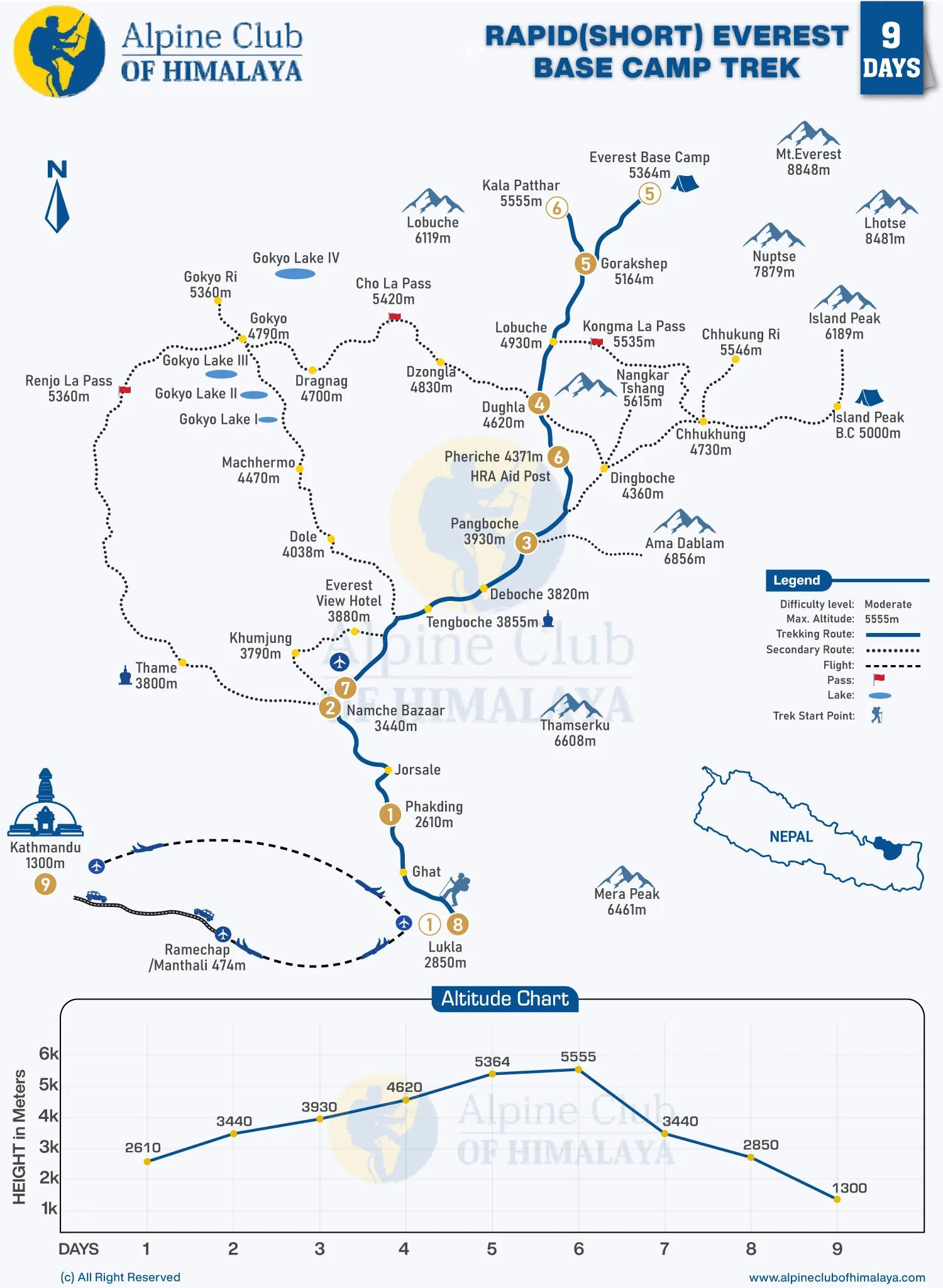
Click on map to view in fullscreen
Trekking Gears and Essential Packing List
For a safe, comfortable, and enjoyable Rapid Everest Base Camp Trek, proper trekking gear is essential. Alpine Club of Himalaya recommends packing the following items to handle the high-altitude environment, changing weather, and trekking demands.
1. Clothing
2. Footwear
3. Backpacks and Bags
4. Sleeping and Bedding
5. Accessories
6. Health and Safety
. Electronics
8. Optional Items
Packing Tips:
· Layering is key for Everest trekking due to varying temperatures.
· Avoid overpacking; your porter will carry heavier items, but your daypack should be light.
· Ensure all essential documents, medicines, and valuables remain in your ACH Kitbag or daypack.
L
Lukas Brandt
Germany
Dec 1, 2025
R
Ryan Mitchell
United Kingdom
Jun 1, 2025
24/7 Support
Need help? we're at your service
Associated With


We Accept Cards

Office of the company registrar License: 66813/066/067 || Tourism Industry Division License:1142
All content and photography within our website is copyright & may not be reproduced without our permission.
Develop By: IT Sansaar