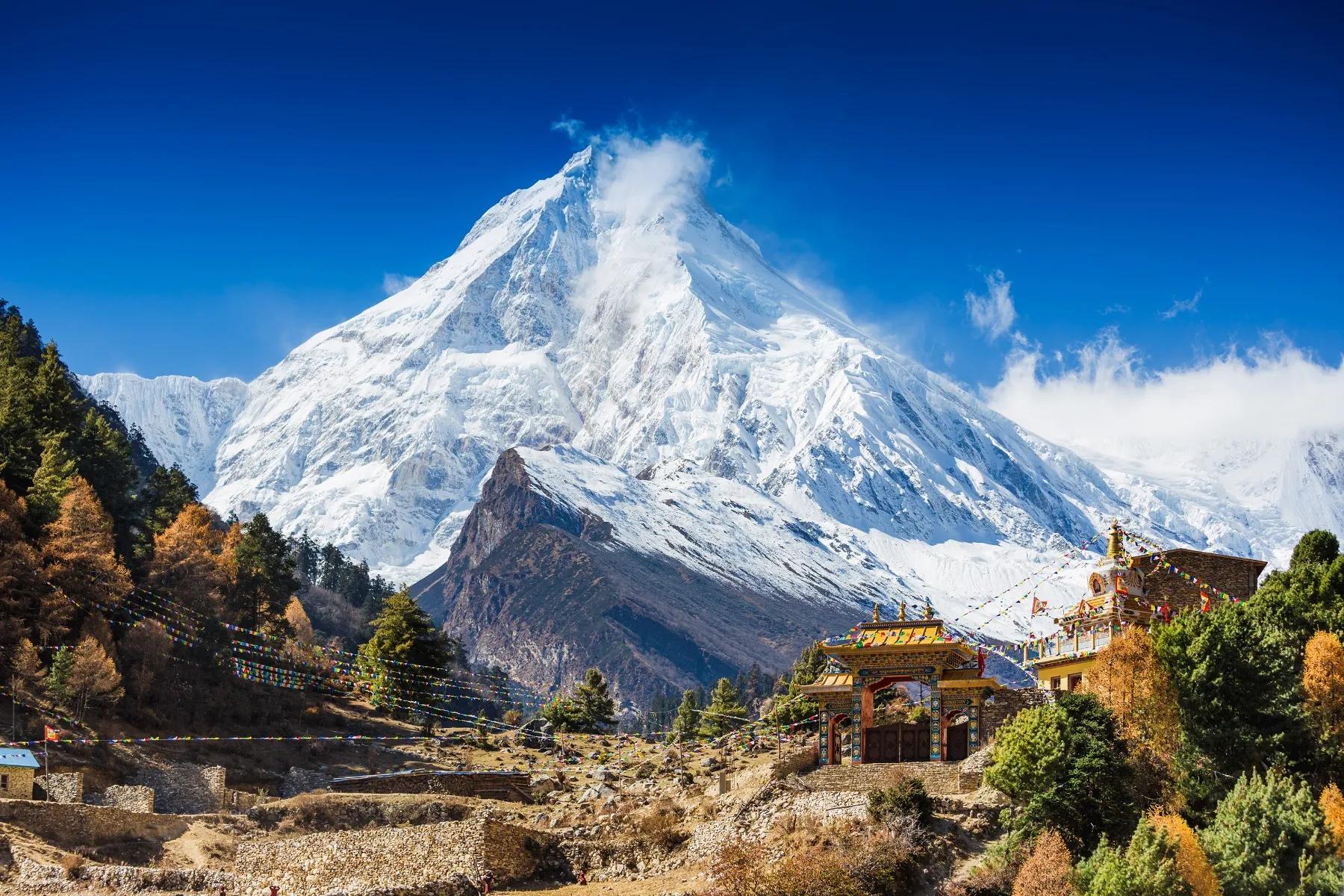
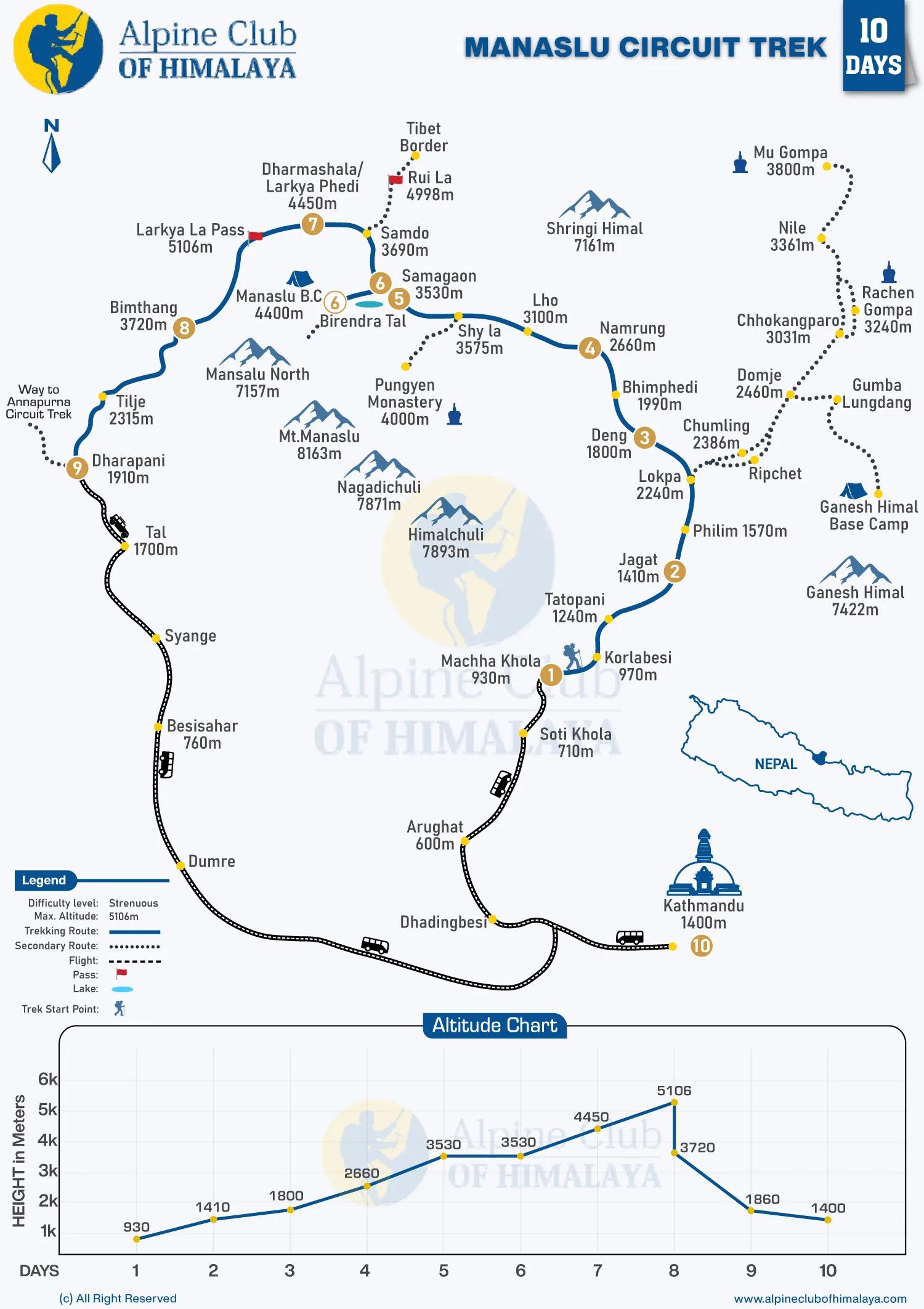
The Manaslu Circuit is a walk around Mount Manaslu (8,163 m), the eighth highest mountain in the world. This 10-day version starts with a drive from Kathmandu to Machha Khola. You then follow the Budhi Gandaki River north through Jagat, Deng and Namrung to Samagaon, the last large village below the mountain. After a rest day there, you cross Larkya La (5,106 m) and come down to Dharapani.
The scenery changes a lot in ten days. You start in subtropical forest and terraced fields, walk through rhododendron and oak woods, and end up among barley fields, yak pastures and glacial moraine. The trail runs through the Manaslu Conservation Area, home to snow leopards and Himalayan tahr, although most trekkers never see them. The villages in the upper valley are Tibetan Buddhist, with mani walls, prayer flags and small monasteries.
You do not need climbing skills. You do need to be fit and ready for long days and cold nights.
Is 10 Days Enough for the Manaslu Circuit?
Yes, the 10-day Manaslu Circuit Trek is possible for fit trekkers when the weather and trail conditions are favorable. It includes a dedicated acclimatization day at Samagaon, with the trek starting with a drive to Machha Khola and crossing Larkya La Pass on day 8. There is no extra buffer day, so bad weather or delays at Larkya La can affect the schedule. We recommend arriving in Kathmandu at least one day before the trek and booking your international flight at least two days after day 10.
The itinerary moves faster than longer Manaslu routes and skips extra nights at Lho, Shyala, and Samdo. If you are new to high-altitude trekking or prefer a slower pace, consider a longer itinerary.
How we run this trek
Your licensed guide walks with you the whole way, handles permits and lodge bookings, and checks your pulse and oxygen level twice a day. One porter carries the bags of two trekkers, so you walk with a daypack. We arrange the permits, transport and lodges. The trek can be booked for one traveler or a large group, and the price per person drops as the group grows. You can also ask for changes, such as a private jeep or extra nights in Kathmandu.
Who this itinerary suits
This plan suits fit trekkers who want the shortest Manaslu itinerary that includes a rest day. It is a better choice than the 9-day Manaslu Circuit Trek if you have not been above 3,000 m before. If you want a slower pace in the upper valley, look at the 13-day Manaslu Circuit Trek.
Difficulty and fitness
The trek is strenuous. Most days are about 6 hours on foot, the pass day takes 7 to 8 hours, and the trail climbs and drops repeatedly above the river gorge. The effort is higher than the distances suggest. Larkya La is the hardest day, because of the altitude and the steep climb. No technical skills are needed. Two months of hill walking with a loaded pack, plus stair climbing, running or cycling three or four times a week, is a sensible preparation. Practice on uneven ground. If you have a heart, lung or knee condition, see your doctor first.
Best time to go
The two good seasons are spring (March to May) and autumn (September to November).
In spring, daytime temperatures in the mountains are about 10 to 15°C, and the lower trail has blooming rhododendron. Views are usually clear in the morning, with more cloud in the afternoon. Autumn is the most stable season, with dry weather, daytime temperatures of 15 to 20°C and cold nights at altitude. It is also the busiest, so book early.
We do not recommend the monsoon (June to August). Heavy rain causes landslides on the road to Machha Khola and muddy trails, and cloud hides the mountains. In winter (December to February) it is very cold, daylight is short and snow can close Larkya La.
Weather on the trail
In the lower valley, daytime temperatures are around 15 to 20°C. Above 3,500 m, nights fall below freezing. On Larkya La the temperature can drop to -10°C or lower, and the wind makes it feel colder. Snow near the pass is common in spring and autumn, and mountain weather can change within an hour, from clear sky to cloud and wind. To be ready, pack layers you can add or remove, a windproof and waterproof shell, insulated gloves, a warm hat, sturdy waterproof boots and trekking poles. Poles help most on snow and ice. Carry sun protection for the daytime and snacks and water for the pass day. If you go in the shoulder months (late May or early September), add rain gear.
A Typical Day on the Trek
A typical day begins around 6:00–7:00 a.m. with breakfast, followed by a health check from your guide. You usually start walking around 7:30–8:00 a.m., taking a short tea break after two to three hours.
Lunch is usually around midday, followed by another two to three hours of walking. Most days involve around six hours on the trail, and you reach the next lodge by mid-afternoon.
After settling in, you can rest or explore the village before dinner around 6:30–7:00 p.m. Your guide gives a short briefing for the next day and checks your oxygen level again before you turn in for the night.
The rest day at Samagaon
You spend two nights at Samagaon (3,530 m), the largest village in the upper valley. On the rest day you walk without your full pack. Birendra Lake (3,450 m) is the shorter outing, a glacial lake close to the village. The trail toward Manaslu Base Camp climbs much higher. How far you go depends on the weather and on how you and the group feel, and your guide decides where to turn around. The rest day does not remove the steep climb from Samagaon to Dharmasala the next day, about 930 m. It does mean you start that climb after two nights at 3,530 m.
Permits and rules
Manaslu is a restricted area, so the rules are stricter than on most Nepal treks.
- You need a Manaslu Restricted Area Permit (RAP). It is issued only through a registered trekking agency. The fee is USD 100 for the first week from September to November and USD 75 from December to August, with a daily fee after that.
- You need a Manaslu Conservation Area Permit (MCAP), which costs about USD 30.
- You need an Annapurna Conservation Area Permit (ACAP), because the route enters that area near Dharapani.
- A TIMS card may also be required. We confirm this when we apply for your permits.
- A licensed guide must accompany you at all times. Solo trekking is not allowed.
- The permit rules ask for a group of at least two people. If you are traveling alone, contact us before booking and we will confirm how it is arranged.
- Camping is not allowed without permission. You sleep in lodges.
The price includes the permits, and we apply for them in Kathmandu. Send us your passport and visa copies as early as you can, especially in autumn, when permits are in high demand. It is illegal to trek in the region without them.
Passport, visa and insurance
Your passport must be valid for at least six months. You can get a tourist visa at a Nepali embassy before you travel or on arrival at Tribhuvan International Airport in Kathmandu. Visas are issued for 15, 30 or 90 days, so pick one that covers your whole stay. Carry photocopies of your passport and visa. Travel insurance is required for this trek. The policy should cover trekking above 5,000 m, emergency helicopter evacuation and medical costs. Cover for cancellation, lost baggage and delays is also useful. Read the terms before you buy.
Altitude sickness and rescue
Altitude sickness comes from lower oxygen at height. The early signs are headache, nausea, dizziness, poor sleep and shortness of breath. Tell your guide as soon as you notice any of them. Do not go higher with symptoms, and descend if they get worse. The best prevention is a gradual climb, plenty of water and a steady pace, and this plan builds in a rest day at Samagaon for that reason. Your guide checks pulse and oxygen saturation twice a day and watches how you look and walk. Ask your doctor about acetazolamide (Diamox) before you travel.
If a rescue is needed, we coordinate it, and the helicopter is paid through your insurance.
Food and drinking water
Meals are simple and filling. Dal bhat (lentil soup with rice) comes with free refills. Other regulars are noodles, fried rice, momos, potatoes, eggs and porridge, and some lodges lower down serve pizza, sandwiches and pancakes. The menu gets shorter higher up, and fresh fruit and vegetables are scarce. Boiled water is sold at most lodges. Bring purification tablets or a filter bottle for water from streams, and do not drink untreated water. Bottled water is expensive higher up and adds plastic to the trail. Drinking enough helps your body cope with altitude.
Accommodation
You sleep in teahouses and local lodges. Rooms are twin-share with a bed, mattress and blankets, and toilets are shared. Higher up the rooms are colder and more basic. The dining room is the warm part of the lodge, and it is where trekkers eat, charge phones and swap stories in the evening. In autumn, lodges fill up, which is one more reason to book early. You can borrow a sleeping bag and down jacket from us.
Guide and porter
The trail is remote and the route is not always marked, so a guide does more than lead. Yours carries a first aid kit, handles permits, lodges and meals, explains local customs and makes the calls about weather and altitude. A porter carries up to 20 to 25 kg, which is the bags of two trekkers. Keep your duffel to about 10 to 15 kg and your daypack to 5 to 8 kg. Most porters are from the region, and hiring them keeps the money in local villages.
Transport
The price includes a shared jeep from Kathmandu to Machha Khola. It takes 7 to 10 hours depending on the road and traffic. The road is partly paved and partly rough, and landslides can slow it in the monsoon. A private jeep is available as an upgrade, and lets you stop where you like. It costs USD 230 out and USD 290 back. Public buses run from New Bus Park in Kathmandu to Arughat (7 to 9 hours), followed by 1 to 2 hours in a local jeep to Machha Khola. They cost less but are crowded and slow. Leave time for delays whichever option you choose.