E
Emily Turner
United Kingdom
Jan 13, 2026

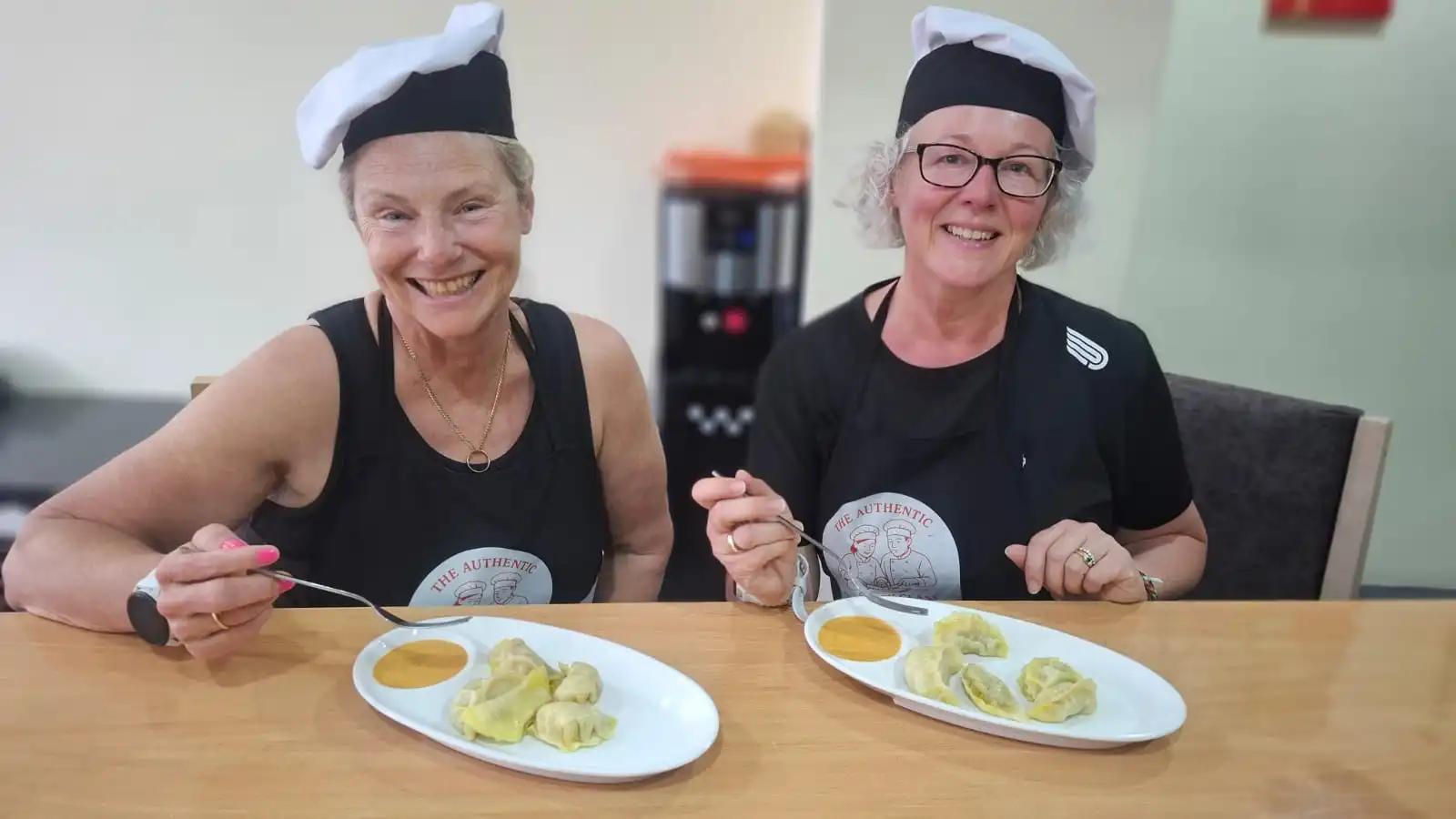
Learning how to make chicken momo and dal bhat was one of the highlights of my Kathmandu trip. The cooking class was fun, interactive, and gave great insight into Nepali culture and food traditions.
Destination
Nepal
Duration
1 Day
Best Weather
Any time of the year
Accommodation
Hotel
Transportation
Private vehicle
Group
Min. 1 Pax
Difficulty
Easy
Activities
Day Tour
Food occupies a central place in Nepali cultural identity. The two dishes that most completely define everyday Nepali cooking — chicken momo and dal bhat - are not simply popular recipes; they represent distinct traditions of preparation, social gathering, and daily sustenance that have shaped Nepali households across generations. Traditional Nepali food recipes like these carry within them the agricultural history of the Himalayan foothills, the spice trade routes that connected Nepal to the Indian subcontinent and Tibet, and the hospitality customs that govern how Nepali families feed and welcome guests.
This article explores traditional Nepali food recipes through two complementary lenses: the cultural and culinary history of chicken momo and dal bhat, and the hands-on cooking experience that cultural tourism in Kathmandu makes available to international visitors. Whether you are seeking to understand these dishes in context, to participate in a Nepali cooking class, or to bring the knowledge of their preparation home, this guide provides the foundational information - the ingredients, the techniques, the cultural context, and the practical logistics of a Kathmandu culinary experience - needed to engage with Nepal's food traditions meaningfully.
A Nepali culinary experience is structured around two principles that distinguish it from cookbook learning: direct participation in preparation and immersion in the cultural context that gives these dishes their meaning. Learning to make chicken momo in isolation from the kitchen culture, family gathering tradition, and ingredient sourcing practices that surround it produces a technically accurate but culturally thin result. The most informative approach to traditional Nepali cooking combines market visits, guided ingredient explanation, hands-on cooking under instruction, and a communal meal that situates the food in the social setting where it normally lives.
The ingredients central to Nepali cooking are accessible but specific in their combination. Turmeric, cumin, coriander, fenugreek, asafoetida, timur pepper (Sichuan pepper grown in the Himalayan foothills), fresh ginger, garlic, and green chili form the flavor architecture of most Nepali dishes. These are not pantry items in most international kitchens, and encountering them in a Kathmandu spice market — whole, fresh, and used in the volumes that Nepali cooking demands — provides a different understanding than reading a list of ingredients.
Momo arrived in Nepal through Tibetan trade and cultural exchange, with Tibetan and Newari communities in the Kathmandu Valley among the earliest adopters and adapters of the form. The Nepali momo has evolved significantly from its Tibetan origins — the filling profile shifted to incorporate local aromatics and spice preferences, the dough thinned, and the achar accompaniment developed as a distinctly Nepali addition with no direct Tibetan parallel.
Today, momo is arguably Nepal's most recognized food export. It is consumed across all social contexts: as street food from steam-cart vendors in Kathmandu, as a family preparation for celebrations and gatherings, as a restaurant staple at every price point, and increasingly as a culturally assertive symbol of Nepali culinary identity in the diaspora communities of the United Kingdom, the United States, and Australia where Nepali migration has been significant.
The standard variations of momo in Nepali cooking are steamed (the traditional and most common form), fried (pan-fried or deep-fried after steaming, producing a crisp exterior), and C-momo (cooked in a chili sauce — a Kathmandu street food innovation). Fillings include chicken, buff (water buffalo), pork, and vegetable combinations including cabbage, potato, and paneer. The filling seasoning — particularly the use of timur and fresh cilantro — distinguishes Nepali momo from Chinese or Tibetan dumplings for those who have eaten all three.
Dal bhat is the foundational meal of Nepali daily life. It is eaten twice a day — once in the late morning and once in the evening — by the majority of Nepali households across all regions, economic levels, and ethnic communities. Its nutritional profile — lentils providing protein and iron, rice providing carbohydrate energy, vegetables providing micronutrients, and the yogurt or pickled achar providing probiotic benefit — has sustained Nepali agricultural communities through physically demanding daily work for generations.
The phrase dal bhat power, 24 hour — a saying among Nepal trekking guides and porters — reflects the practical caloric and nutritional significance of the meal. Guides and porters on the Everest and Annapurna routes who eat dal bhat twice daily consistently report higher sustained energy levels and faster physical recovery than those eating Western trail foods, a practical observation that resonates with the dish's nutritional composition.
Regional variations in dal bhat are significant. In the Terai (lowland) regions bordering India, the dal tends to be thinner and more vigorously spiced. In the hill and mountain regions, the dal is thicker and the tarkari more likely to include locally grown vegetables such as gundruk (fermented leafy greens) and dhido (a millet or buckwheat porridge substituted for rice at higher elevations). In Newari communities of the Kathmandu Valley, the dal bhat meal may be accompanied by additional preparations specific to Newari food culture, including roasted soybeans, beaten rice preparations, and specific meat dishes.
Cooking tour duration in Kathmandu typically ranges from four to eight hours depending on the depth of market experience included and whether a single or multiple dish preparation is involved. The full-day format described in the itinerary above — market visit plus momo and dal bhat cooking — runs approximately seven to eight hours including travel. Shorter half-day formats covering either momo or dal bhat preparation without the market component are available and take three to four hours.
Group sizes for cooking experiences are generally kept small — four to eight participants is the typical range for a teaching kitchen format, as individual attention to the momo wrapping technique and the tarka preparation benefits from a low instructor-to-participant ratio. Larger groups can be accommodated with multiple instructors but may have a more demonstration-oriented rather than participatory character.
Vegetarian options are fully accommodated on these experiences. Dal bhat is inherently vegetarian in its standard format, and a vegetable momo filling — typically cabbage, carrot, onion, ginger, garlic, and the same spice profile as the chicken version — is a standard alternative to the chicken filling. Vegan participants should specify requirements in advance, as ghee is used in the tarka preparation and dairy-free alternatives can be arranged.
No prior cooking experience is required. The techniques involved — knife work, spice tempering, momo wrapping — are learned during the session under instruction. The momo wrapping is the most technically challenging element, and participants should expect to improve over the course of the session rather than produce perfect results immediately. The cooking environment is a functional kitchen rather than a demonstration studio, and hygiene standards in operator-run experiences are maintained to the level expected for food preparation for international visitors.
Nepali food culture is shaped by a hospitality ethic in which feeding a guest is a fundamental expression of respect and welcome. The word atithi — meaning guest — carries a cultural weight in Nepali (and broader South Asian) tradition that positions the visitor as a person to whom one owes a certain form of care. Refusing a offered meal in a Nepali household is generally understood as a social rejection, and accepting food — and eating it with visible appreciation — is one of the simplest and most effective ways for a visitor to communicate respect for the household and the culture.
The importance of fresh ingredients in Nepali cooking reflects both the agricultural tradition of the country and the practical reality of a food culture that, until recently, had limited access to refrigeration. The preference for freshly ground spices over packaged blends, for vegetables purchased the morning of preparation, and for meat from a butcher known to the household rather than a supermarket are practices that persist in Nepali cooking even as urban households gain greater access to convenience food options. A Nepali cooking experience that begins at the morning market is replicating this practice faithfully.
Spices in Nepali cooking serve functional as well as flavor purposes. Turmeric has been used in Nepali household medicine and food preparation for centuries, with an anti-inflammatory and preservative role recognized long before its contemporary international health food profile. Fenugreek seeds in the dal tarka are used specifically in lentil preparations because their compounds are understood in Ayurvedic tradition to counteract the digestive heaviness that legumes can produce. These functional relationships between ingredients and their effects inform how Nepali cooks use spices — not as flavoring choices to be varied by preference, but as specific and purposeful additions to specific dishes.
Alpine Club of Himalaya, primarily known as a Nepal-registered trekking and expedition company, organizes cultural activity programs in Kathmandu alongside its trekking and mountaineering operations. These programs include cooking experiences structured around traditional Nepali food preparation — organized as standalone Kathmandu activities for travelers not undertaking a full trekking itinerary, or as cultural add-ons for trekkers arriving early or departing late from a Himalayan route. Their approach to culinary experiences follows the market-visit-plus-cooking format, working with local instructors and using family kitchen settings rather than commercial demonstration venues. For travelers seeking to combine a Nepal trekking program with structured cultural engagement in Kathmandu, operators with this range of activity provide a more integrated experience than working with separate specialist providers.
Traditional Nepali food recipes — and the cultural context that gives them their meaning — are most fully understood through participation rather than observation. Chicken momo and dal bhat are not complicated preparations in a technical sense; their depth comes from the accumulated knowledge of proportions, spice sequencing, and cooking judgment that is transmitted through direct instruction and practice rather than through written recipes alone. A Kathmandu cooking experience that begins at the morning market and ends at a shared meal table provides access to that transmission in a way that reading a recipe cannot replicate.
The two dishes covered here — momo in its pleated, steamed form with tomato-timur achar, and dal bhat in its full tarka-finished, multi-component structure — represent complementary dimensions of Nepali food culture. Momo speaks to the social and celebratory dimension of Nepali eating: the gathering to wrap and cook together, the street-side sociability, the informal pleasure of a shared plate. Dal bhat speaks to the daily and sustaining dimension: the twice-a-day rhythm, the nutritional completeness, the expression of household care in a meal that is always freshly prepared and always offered with more.
For travelers visiting Nepal, engaging with these dishes at the level of their preparation — rather than simply ordering them from a menu — produces a form of cultural understanding that extends beyond the kitchen and enriches the broader experience of the country.
Participants are collected from a central Kathmandu meeting point — typically in the Thamel district — and introduced to the day's guide and cooking instructor. A brief orientation covers the day's structure, the two dishes to be prepared, and any dietary requirements or restrictions that will shape ingredient selection. The group then travels by vehicle or on foot to the morning's first destination: a local fresh produce market.
Hotel pickup and drop-off in Kathmandu
Local market and spice market visit
Professional cooking instructor
Hands-on cooking experience
Chicken momo preparation class
Dal bhat cooking session
Traditional momo achar preparation
Fresh cooking ingredients and spices
Use of kitchen equipment and apron
Lunch/meal with prepared dishes
Nepali tea experience
Cultural interaction and food explanation
Recipe guidance during the session
Vegetarian option available
Small group cultural experience
E
Emily Turner
United Kingdom
Jan 13, 2026
L
Lucas Meyer
Germany
Jan 3, 2026
24/7 Support
Need help? we're at your service
Associated With


We Accept Cards

Office of the company registrar License: 66813/066/067 || Tourism Industry Division License:1142
All content and photography within our website is copyright & may not be reproduced without our permission.
Develop By: IT Sansaar