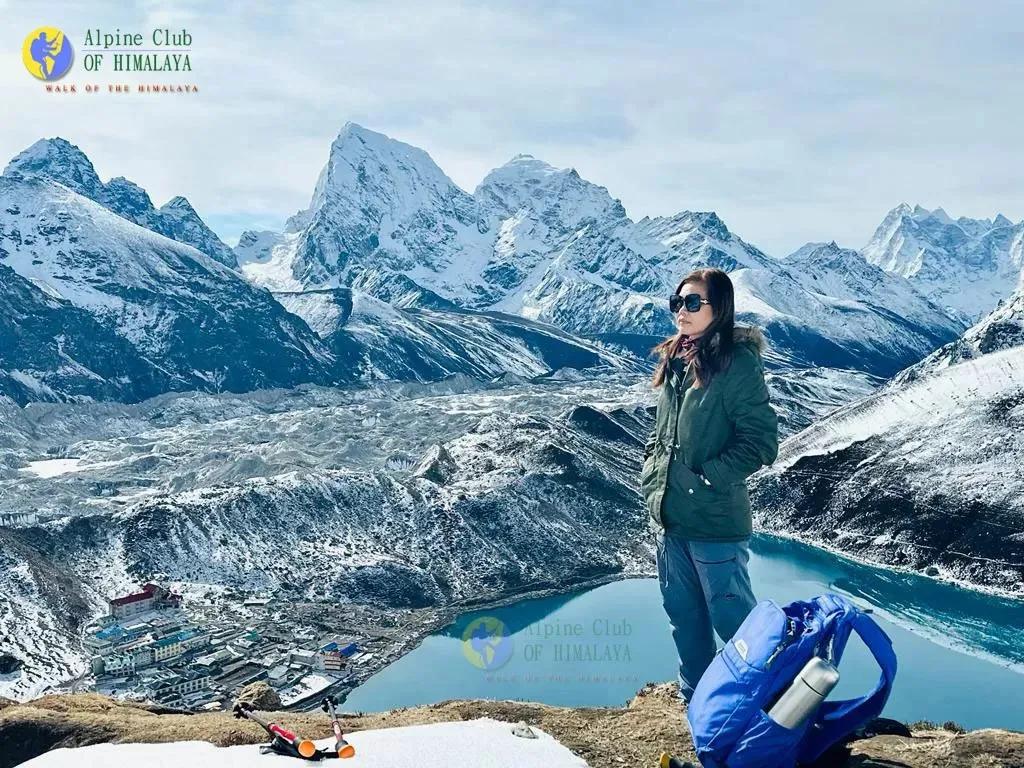
The Gokyo Valley Short Trek is an 11-day route through Nepal's Khumbu region, passing the Gokyo Lakes, the Ngozumpa Glacier and the viewpoint at Gokyo Ri. It runs on quieter trails than the Everest Base Camp route and passes through several Sherpa villages. Alpine Club of Himalaya guides the trek and arranges teahouse accommodation throughout. The Ngozumpa is the longest glacier in the Himalayas, running for about 36 km down from Cho Oyu. Gokyo Ri, at 5,357 m, looks out over four peaks above 8,000 m: Everest, Lhotse, Makalu and Cho Oyu.
Quick Facts
-
Duration: 11 days, including arrival and departure
-
Trek grade: moderate to challenging
-
Highest point: Gokyo Ri, 5,357 m
-
Route: Kathmandu to Lukla by flight, then back to Kathmandu
-
Accommodation: 3-star hotel in Kathmandu; teahouses on the trek
-
Meals: breakfast in Kathmandu; breakfast, lunch and dinner on the trek
-
Best season: spring (March to May) and autumn (September to November)
-
Permits: Sagarmatha National Park permit and TIMS card, arranged by Alpine Club of Himalaya
-
Trekking mode: guided, with licensed guide and porter support
-
Group size: 1 to 12 people; private trips available
-
Transportation: domestic flight, Kathmandu to Lukla to Kathmandu
-
Electricity and Wi-Fi: available in most teahouses for an extra charge
-
Drinking water: boiled water, bottled water, or purification tablets
-
Emergency: helicopter evacuation available; insurance required
Gokyo Valley Trek Distance, Duration and Altitude
| Route |
Distance |
Walking Time |
Altitude |
| Lukla to Phakding |
7.8 km |
3 to 4 hours |
2,610 m |
| Phakding to Namche Bazaar |
10.4 km |
5 to 6 hours |
3,440 m |
| Namche Bazaar to Dole |
10 km |
6 to 7 hours |
4,110 m |
| Dole to Machhermo |
10 km |
5 to 6 hours |
4,470 m |
| Machhermo to Gokyo |
7 km |
4 to 5 hours |
4,790 m |
| Gokyo to Gokyo Ri (round trip) |
6 km |
3 to 4 hours |
5,357 m |
| Gokyo to Namche Bazaar |
17 km |
7 to 8 hours |
3,440 m |
| Namche Bazaar to Lukla |
15.4 km |
7 to 8 hours |
2,840 m |
Gokyo Ri and the View from the Top
Gokyo Ri sits at 5,357 m above the west side of Gokyo village. The climb takes 2 to 3 hours and is steep in places, though it involves no technical climbing. On a clear morning the summit gives views of four peaks over 8,000 m: Everest (8,849 m), Lhotse (8,516 m), Makalu (8,485 m) and Cho Oyu (8,188 m). Nearby peaks visible from the ridge include Ama Dablam (6,812 m), Thamserku (6,608 m), Kantega (6,685 m), Cholatse (6,440 m) and Taboche (6,542 m), along with the Gokyo lakes and the Ngozumpa Glacier below.
Route to Gokyo
The trek starts with a flight from Kathmandu to Lukla. From Lukla the trail follows the Dudh Kosi valley to Phakding, passing Mount Khumbila, a peak considered sacred by the Sherpa community that has never been climbed.
From Phakding the trail climbs through pine forest and crosses several suspension bridges before reaching Namche Bazaar, the main trading town of the Khumbu. Namche has markets, monasteries, bakeries and viewpoints, and most itineraries include a rest day here for acclimatization. Beyond Namche the trail passes through Dole and rhododendron forest to Machhermo, a village with local stories about Yeti sightings. Further on, the valley opens up with views of Cho Oyu and nearby peaks. The trail then follows the moraine of the Ngozumpa Glacier to Gokyo, a settlement on the shore of the third Gokyo lake, known locally as Dudh Pokhari.
Days at Gokyo
Fourth and Fifth Gokyo Lakes
From Gokyo, trekkers can walk to the fourth lake, Thonak Tsho, about 3 km north, and on to the fifth lake, Ngozumpa Tsho, where the terrain is more remote.
Scoundrel's Viewpoint
Scoundrel's Viewpoint, near the fifth lake, looks out over Cho Oyu, Everest, Lhotse, Nuptse, Makalu and Gyachung Kang, as well as the Ngozumpa Glacier.
Extending the Trek: Renjo La and Cho La
Renjo La
Trekkers with extra time and good acclimatization sometimes extend the Gokyo Valley Trek into a longer circuit. One option crosses Renjo La (5,360 m) from Gokyo down to Lumde and Thame before rejoining the main trail at Namche Bazaar, adding roughly 2 to 3 days.
Cho La and Everest Base Camp
Another option crosses Cho La (5,420 m) from the Gokyo side to Dzongla and on to Everest Base Camp, joining the classic Everest Base Camp trail, which adds 4 to 6 days.
Both passes involve exposed, sometimes icy terrain and are best attempted only after several days of acclimatization. Alpine Club of Himalaya can adjust the itinerary to include either option on request.
Return Journey
From Gokyo the trail retraces its route through Machhermo, Dole and Namche Bazaar, then descends along the Dudh Kosi River to Lukla. A flight the next morning returns trekkers to Kathmandu.
Best Time to Trek
Spring: March to May
Spring brings generally favorable trekking conditions, and rhododendrons and other alpine flowers are in bloom.
Autumn: September to November
Autumn tends to have clear skies and stable weather, making it one of the main trekking seasons in the Everest region.
Monsoon: June to August
The monsoon brings heavy rain and landslides, and trails can be muddy or blocked.
Winter: December to February
Winter brings snow at higher elevations, which can close some trails. Temperatures vary widely between day and night at altitude, so trekkers should carry layered clothing and be ready for sudden changes in weather.
Gokyo Valley Trek Difficulty
The Gokyo Valley Trek is rated moderate to challenging. The trail includes steady ascents and descents, rocky paths and glacial moraine, and reaches over 5,300 m at Gokyo Ri. Trekking days typically run 5 to 8 hours over uneven terrain, with the longest day being the descent from Gokyo to Namche Bazaar. No technical climbing skills are required, but trekkers should be fit and prepared for the altitude.
Physical Fitness
A good level of fitness helps on this trek. Cardiovascular exercise such as hiking, running, cycling or swimming beforehand is recommended, along with practice hikes carrying a loaded backpack. Prior trekking experience is useful but not required.
Altitude Sickness and Preparation
The trek reaches above 5,000 m, where altitude sickness is a real risk, and symptoms can start to appear above about 3,000 m.
Symptoms include headache, dizziness, nausea, fatigue, loss of appetite, trouble sleeping and shortness of breath. The itinerary includes acclimatization days in Namche Bazaar and Gokyo. Trekkers should ascend slowly, stay hydrated, eat well and pay attention to how their body responds. Diamox (acetazolamide) can help but should only be taken after talking to a doctor. Alcohol and smoking are best avoided during the trek. If symptoms appear, the response is to stop ascending or descend, not to push on. Guides from Alpine Club of Himalaya watch trekkers for signs of altitude sickness and carry a pulse oximeter to check oxygen levels.
Emergency Evacuation
Helicopter evacuation is available from Gokyo, Namche Bazaar or Lukla in the event of severe altitude sickness or another medical emergency. The cost of evacuation is not included in the trek package, so travel insurance covering emergency evacuation and medical treatment at high altitude is required. Guides and porters are trained in first aid and can coordinate evacuation logistics.
Wi-Fi and Electricity
Wi-Fi
Wi-Fi is available in most teahouses along the route, usually for a small fee, though the connection is often slow and can drop out. Coverage gets less reliable at higher, more remote stops such as Gokyo and Machhermo.
Electricity
Electricity is generally supplied by solar panels or small hydropower systems, and outages happen, especially in bad weather. Charging is often limited to certain hours and usually costs extra.
A portable power bank and a universal travel adapter are worth carrying. Nepal uses Type C, D and M plugs, with 230V/50Hz electricity.
Meals During the Gokyo Valley Trek
Tea houses along the route serve Nepali, Tibetan, Indian and some Western dishes. Dal bhat, momos and thukpa are common options, alongside bread, soup and baked goods. Vegetarian meals are available at every stop, and eating vegetarian at altitude is generally easier on digestion than heavy meat dishes.
Breakfast
Tibetan bread, chapati, eggs, vegetable curry, porridge, cornflakes, pancakes, oats, muesli and baked pastries are commonly available, usually with tea or coffee.
Lunch
Lunch options include dal bhat, momos, thukpa, fried rice, sandwiches and soups, with pizza or pasta available at some teahouses.
Dinner
Dinner may include Sherpa stew, thukpa, steamed vegetables and other simple dishes, with desserts such as rice pudding or apple pie available at some teahouses.
Drinking Water
Most teahouses sell boiled or filtered water. Trekkers are also advised to carry purification tablets, chlorine drops or a solar water disinfection setup. Bottled water is sold along the trail but is discouraged in some sections to reduce plastic waste.
Accommodation
Accommodation is in teahouses throughout the trek.
In smaller villages, rooms are simple and twin-shared, with a bed, pillow, blanket and basic furniture. In larger villages such as Namche Bazaar and Gokyo, rooms tend to be more spacious, with better heating and sometimes hot showers, usually for an extra charge. Camping is also possible on some sections of the trail, with equipment arranged by the trekking company.
Travel Insurance
Alpine Club of Himalaya requires trekkers to carry travel insurance that covers emergency evacuation, high-altitude rescue, injury, hospitalization and repatriation. Insurance should specifically include helicopter rescue at altitudes up to at least 6,000 m, since standard policies sometimes cap coverage lower than the trek's highest point.
Passport & Visa
All travelers must carry a valid passport with at least six months of validity from the date of entry into Nepal. Most foreign nationals require a tourist visa, which can be obtained either in advance from a Nepalese Embassy or Consulate or upon arrival at Tribhuvan International Airport (TIA) in Kathmandu.
For the most up-to-date visa information, eligibility, visa fees, and online application details, please visit the official website of the Department of Immigration, Nepal: https://www.immigration.gov.np/visa-information
Porter and Guide Services
Solo trekkers are assigned a guide who also carries their gear. Groups of two or more get additional guides and porters as needed, typically one porter for every two trekkers, each carrying up to about 20 to 25 kg.
Guides speak English and know the region's culture and history. Porters carry the heavier loads.
Transportation
Alpine Club of Himalaya arranges airport transfers, the domestic flight to and from Lukla, and any road transfers between cities and trailheads. Private and shared vehicle options are both available.
Extra Personal Expenses
The trek package covers meals and accommodation as set out in the itinerary. Trekkers should budget separately for snacks and drinks beyond meals, phone or internet use, hot showers, battery charging, laundry, tips for guides and porters, and souvenirs.
Carrying a mix of Nepalese cash and a card is a good idea, since costs vary by person and by trek length. Credit cards are rarely useful outside Kathmandu.
Gokyo Valley Trek Permits
The trek requires two permits: the Sagarmatha National Park entry permit and the Khumbu Pasang Lhamu Rural Municipality entrance permit.
Sagarmatha National Park Permit
The park permit costs NPR 3,000 (NPR 1,500 for SAARC nationals) and is available at the Nepal Tourism Board office in Kathmandu or at the park entrance in Monjo. A passport or photocopy is required.
Khumbu Pasang Lhamu Rural Municipality Permit
The rural municipality permit costs NPR 2,000 and is issued near Lukla.
Alpine Club of Himalaya arranges both permits in advance.
Why Choose the Gokyo Valley Trek?
The Gokyo Valley Trek follows quieter trails than the Everest Base Camp route, through woodland, past glacial lakes and across alpine terrain. It passes Sherpa villages where traditional ways of life continue, and it takes in views of Everest, Cho Oyu, Lhotse and Makalu along the way. Many trekkers who have done both routes rate the summit view from Gokyo Ri as comparable to, or better than, the view from Kala Patthar on the Everest Base Camp trek, with fewer people sharing the viewpoint.
Getting to Lukla
Lukla's Tenzing-Hillary Airport sits at 2,860 m and is the starting point for most Gokyo Valley treks. Flights from Kathmandu take about 25 to 40 minutes. Outside the main trekking seasons, flights leave from Tribhuvan International Airport in Kathmandu, operated by airlines including Tara Air, Summit Air and Sita Air, usually early in the morning. During the busier spring and autumn seasons, flights are often rerouted through Ramechhap Airport, about 4 to 5 hours from Kathmandu by road, to ease congestion at Kathmandu's airport.
Lukla Flight Delays
Lukla's short runway and mountain location make flights vulnerable to weather delays. Fog, wind and low visibility can cause delays or cancellations even in peak season.
Alpine Club of Himalaya recommends building in 1 to 2 buffer days at the end of the trek before an international flight out of Kathmandu.
Helicopter Options
Helicopter transfers can be arranged instead of the fixed-wing flight, including Kathmandu to Lukla at the start of the trek, or from Gokyo or Namche Bazaar to Lukla or directly to Kathmandu afterward.
Group sharing can reduce the cost.
Overland Alternative: Jiri or Salleri
Trekkers who prefer not to fly can start from Jiri or Salleri, following the route used by early Everest expeditions.
This adds several days of trekking through lower-altitude villages and forest, which helps with acclimatization, at the cost of extra time. Private or public transport connects Kathmandu to Jiri or Salleri.
Responsible Tourism
Environmental Practices
Guides and porters follow "leave no trace" principles, carrying out waste and avoiding single-use plastic bottles where possible.
Local Employment
Local guides, porters and staff are hired with fair wages, insurance and safe working conditions, and the company works with local teahouses and shops.
Cultural Awareness
Guides brief trekkers on local customs and etiquette around monasteries and other religious sites. The Gokyo lakes themselves are considered sacred by both Hindus and Buddhists, and some Nepali pilgrims visit them, especially around the Janai Purnima festival.
Late Booking
Alpine Club of Himalaya can arrange the Gokyo Valley Trek on short notice, including permits, the Lukla flight, accommodation and other logistics. Booking in advance is still recommended for the busy spring and autumn seasons, when flight and teahouse availability is tighter.
Pre-Trek Briefing
Alpine Club of Himalaya offers an online briefing before arrival in Nepal, covering the itinerary, packing, altitude sickness prevention, safety and gear, along with a chance to ask questions about permits and travel arrangements.
Before You Go
The Gokyo Lake Trek is an 11-day route through the Everest region, with views of Everest, Lhotse, Cho Oyu and the Gokyo Lakes, and time in Sherpa villages along the way. It reaches over 5,000 m at Gokyo Ri, so a reasonable level of fitness matters more than prior trekking experience. Pack layered clothing, broken-in trekking boots and cold-weather gear, and talk to your doctor about altitude medication if needed.
Cancellation Policy
Cancellation by the Participant
- 60+ days before departure: 20% of the trek cost is retained
- 30 to 59 days before departure: 50% of the trek cost is charged
- Less than 30 days before departure: no refund (100% of the trek cost is charged)
These charges cover pre-booked costs such as flights, permits and accommodation.
Cancellation by the Organizer
If Alpine Club of Himalaya has to cancel the trek due to weather, political unrest, natural disaster or safety concerns, you can choose a full refund or reschedule to a future date at no extra cost.
Force Majeure
Alpine Club of Himalaya is not responsible for delays, cancellations or extra costs caused by events outside its control, including natural disasters, political unrest or border closures, health emergencies, and transportation disruptions such as flight delays or strikes. Any related personal costs, such as extra hotel nights or rerouted transport, are the participant's responsibility. Comprehensive travel insurance covering high-altitude trekking, medical evacuation, trip cancellation and force majeure is strongly recommended.